Browser security is one of the fastest-growing investment areas in enterprise security. It's clear that security teams need browser security solutions, but the challenge is often figuring out how to fund it.
Browser security is one of the fastest-growing investment areas in enterprise security. It's clear that security teams need browser security solutions, but the challenge is often figuring out how to fund it.
Omdia's 2026 research found that 86% of organizations have already increased browser security spending in response to emerging threats, and 85% expect to spend more over the next 12–24 months.
But finding budget for browser security solutions can be harder than it is for other security tools. Both Gartner and Omdia independently confirm that browser security is predominantly additive; Gartner states explicitly that secure enterprise browsers augment rather than replace existing security controls, and Omdia found that 80% of organizations expect to deploy browser security alongside their current stack.
In practice, that means there's typically no legacy line item to redirect or renewal to swap out. Instead, security leaders are left needing to build a business case from scratch, creating more work on top of an already demanding role. Having a proven framework that other security leaders are already using successfully makes that process significantly faster.
Push helps security leaders build these business cases every day and we've seen firsthand what works and where the budget comes from.
This article distills those patterns into a practical framework you can use to build your own investment case, as well as provides real-world examples of how Push's customers have found budget to make their own investments in browser security tooling:
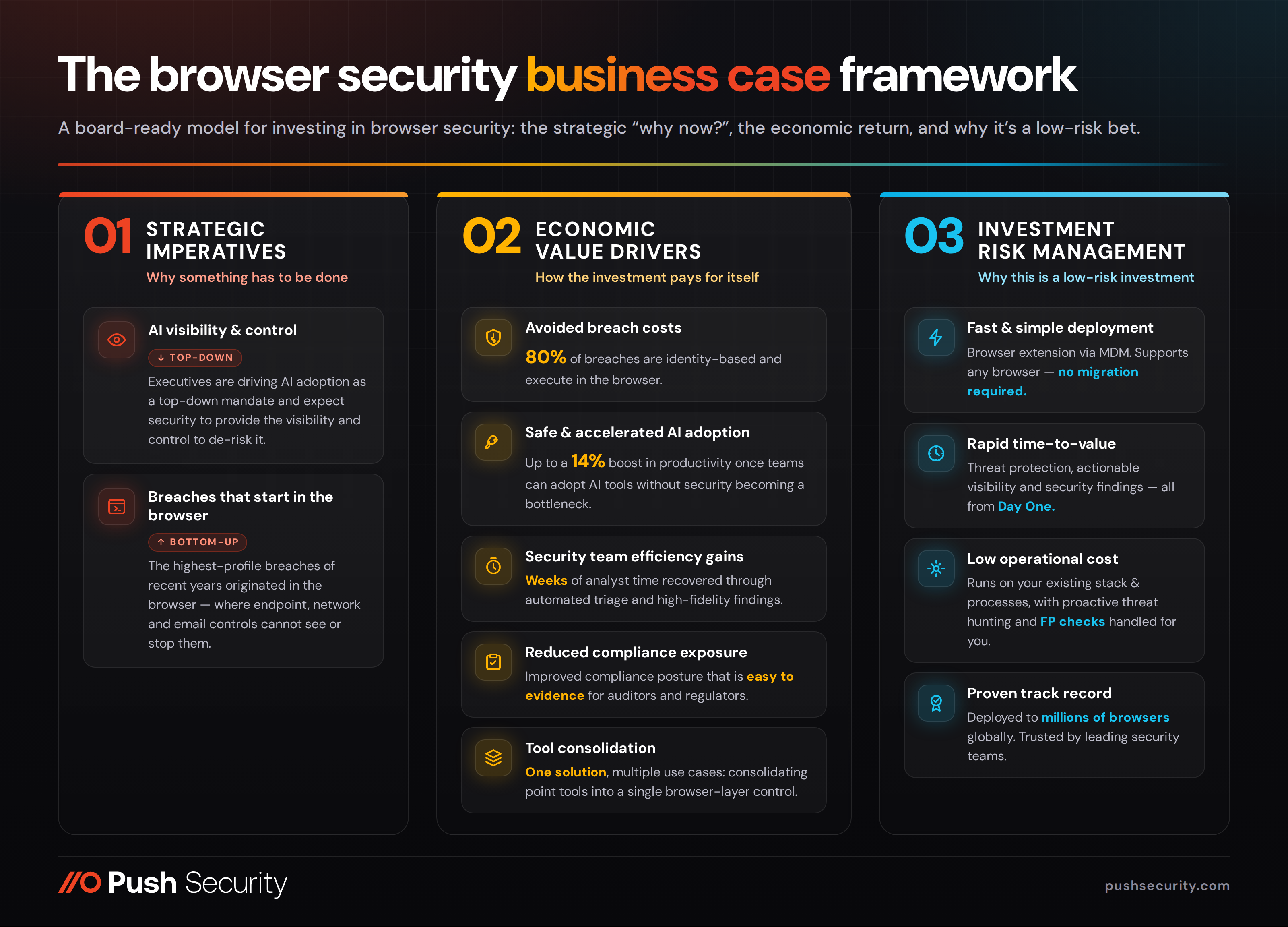
The strategic imperatives that resonate with non-security executives
Two distinct strategic initiatives consistently prove to be effective in unlocking browser security budget. They come from different directions; one is driven by the board down to security, the other is driven by security up to the board. But both lead to the same investment and can be used in conjunction with one another.
Option A | AI visibility and control: the mandate security teams are responding to
AI adoption isn't a security initiative; it's a business strategy decision that executives and boards are driving. They know the organization needs to harness AI to remain competitive, and most have already committed to accelerating its use. But they also know that adoption without visibility creates risks they can't quantify or manage, and they expect security to have the visibility and controls to close that gap.
The browser is the most practical place for security teams to get that visibility and control over AI usage. All AI tool usage — whether that's web apps, extensions, OAuth consent flows, data uploads — traverses the browser. A browser security platform like Push can discover which AI tools employees are actually using, monitor how they're being used, track which AI services have been granted access to corporate systems, and enforce policy in real time.
What makes this particularly effective in a budget conversation is that security teams don’t need to explain or sell a new security risk or initiative, instead they're responding to one their executive team has already identified. When security can demonstrate a concrete plan to deliver AI visibility and control, the funding conversation is significantly shorter. The investment addresses the executive mandate while simultaneously providing additional capabilities for the security team like threat protection, identity and shadow IT security, and investigation support.
Option B | Modern breaches that originate in the browser: the gap the existing stack wasn't designed to cover
The second strategic imperative requires more educating on the part of the security leader.
The highest-profile breaches in recent years — MGM, Caesars, Ticketmaster, M&S, Jaguar Land Rover — were all carried out by threat groups like Scattered Spider using cloud-native, identity-based attack techniques. They didn't compromise endpoints or exploit zero-day vulnerabilities. Instead, they compromised employees' cloud app accounts by targeting them with techniques that play out inside browser sessions where existing endpoint, network, and email controls have no visibility.
That doesn't mean your existing security investments are failing. Endpoint, network, and email controls have become effective enough that threat groups are now actively avoiding them by rerouting their attacks via the browser.
CrowdStrike's 2026 data shows 82% of attack detections are now malware-free. A new capability is needed to address this new playbook, and browser security closes that gap by detecting attacker behavior inside the session, where these attacks actually execute.
Unit 42 found that identity weaknesses played a material role in almost 90% of their investigations, and across more than 750 incident response engagements, 48% involved browser-based activity.
Mandiant's data tells a similar story: threat actors exploited identity issues to gain initial access in 83% of incidents involving cloud and SaaS environments.
Identity-based attacks executed via the browser are now the dominant attack pattern. That framing works in a budget conversation because it identifies a gap rather than asking to improve something that's already covered by an existing solution. It's also reinforced by the fact that the breaches and groups behind them like Scattered Spider were all reported on by the mainstream media, meaning non-security stakeholders are likely to already be somewhat aware of the risks and potential implications of them being realized.
The economic case: five value drivers
Those strategic imperatives establish why something needs to be done, but they don't quantify the cost of inaction or demonstrate how the investment pays for itself. A CFO wants to see where the money comes from, what existing spend it offsets, and what measurable return it delivers. The economic investment case draws on five distinct value drivers, each grounded in capabilities specific to operating inside the browser session.
To illustrate the potential economic impact, each value driver below includes an estimate for a hypothetical 1,000-employee US technology company called ACME. The assumptions used are conservative and the benchmarks are publicly available. And while your own numbers will differ, the methodology used is transferable.
Using these estimates, ACME can conservatively expect a return of $435K–$925K in combined annual value from direct labor savings, risk-adjusted cost avoidance, and accelerated productivity gains.
1. Avoided breach costs
This is the largest single value driver, but it's also the hardest to measure because the return is defined by the absence of an event rather than the presence of a saving. That said, the methodology is well-established in risk management, and CFOs already accept this logic for insurance and business continuity investments.
The detection gap described above has a direct financial consequence: every attack that slips through undetected is a potential breach incurring significant direct and indirect costs. Push helps you avoid these costs by detecting browser-native attack TTPs and blocking them in real-time to prevent breaches at the earliest opportunity.
Even though the breach itself is unrealized, there are tangible leading indicators of success: reduced MTTD/MTTR, and fewer attacks progressing to account takeover or endpoint compromise; the stages at which incidents become more expensive to clean up.
Quantifying the savings generated by avoiding breaches requires an estimation of your organization's breach probability and likely cost. IBM's cost of a data breach report provides industry-specific benchmarks, though a more grounded alternative is to look at the disclosed costs of the breaches mentioned above and assess your exposure to the same techniques:
MGM reported over $100M in direct impact plus a $45M class-action settlement.
M&S lost £300M in profits with almost £1B wiped off its market valuation.
The JLR breach was severe enough for the UK government to underwrite a $1.5B loan to mitigate supply chain damage.
Your own incident data, red team results, or phishing simulation outcomes will increase accuracy further.
ACME example: IBM's data puts the average breach cost for a technology company at approximately $4.9M. Assuming a conservative 5–8% annual breach probability, and given that 80% of breaches are now identity-based and execute via the browser, the question is how much of that exposure Push eliminates. Push detects and blocks browser-native, identity-based attacks in real time. Even using a conservative 80% effectiveness estimate the expected annual value is $150K–$250K.
2. Accelerated and safe AI adoption
Without effective AI visibility and control tooling, your security team becomes either the bottleneck for AI adoption or allows the risks to go unchecked. Every month that adoption is restricted or ungoverned has a productivity cost that compounds.
There's been plenty of research into the productivity impact of AI:
Stanford and MIT research found that workers with access to a generative AI assistant were 14% more productive on average, with novice workers seeing a 34% improvement.
Accenture's research estimates approximately $7,800 per employee per year in productivity value from generative AI for knowledge workers.
The Federal Reserve independently quantified it at 5.4% of work hours saved, roughly one full working day reclaimed per month.
McKinsey's 2025 data shows organizations leading on AI adoption report 5.8x average ROI within 14 months, and they outperform laggards in both profitability and revenue growth.
A browser security platform like Push removes the governance blocker. When you can see which AI tools employees are using, what data they're sharing, and what permissions they've granted, and enforce policy in real time, the answer to "can our people use this?" shifts from "not yet, we need to assess the risk" to "yes, with our sensible guardrails."
Push delivers this by discovering every AI web app, browser, browser extension, and OAuth integration in use. It monitors data sharing through file uploads and clipboard activity, tracks OAuth consent flows where AI services request access to corporate tenants, and enforces policy at the point of action. This allows your team to very quickly get a handle on AI usage, mitigate risks and guide the business on how to best drive safe adoption.
ACME example: for a 1,000-employee technology company where 60% of the workforce are knowledge workers, accelerating safe AI adoption by three to six months for 25–40% of those workers captures $150K–$400K in productivity value.
3. Greater return from existing security investments
Push generates direct labor savings in two ways that other tools can't replicate.
First, identity hygiene remediation at scale. Push's customer data shows that for every 1,000 employees, an organization will typically have just over 2,500 identity security vulnerabilities (missing MFA or weak, breached, reused passwords, etc).
Without Push, you could conservatively estimate that each vulnerability takes 5–10 minutes to resolve manually (inclusive of project management and reporting time) which translates to between 26 and 52 FTE days per thousand employees. Push automates this through in-browser guardrails that prompt users to fix issues at the point of login. That's thousands of identity vulnerabilities resolved without a single ticket being filed, and weeks of analyst time recovered annually at fully burdened rates.
Second, investigation efficiency. Push detects attacks at the earliest and safest opportunity, as the attacker is attempting to gain initial access via the browser. The telemetry Push provides analysts with accelerates their investigations across both external and insider threats.
Here’s one example of that in action: Push eliminates over 99% of compromised credential false positives in common TI feeds by only surfacing credentials actively being used and observed in the browser. Much like the first direct labour saving, Push saves your team weeks of effort confirming false positives and investigating complex account compromise incidents. It also reduces the likelihood of an incident progressing to the stage where a (costly) external incident response provider is needed.
By automatically remediating identity security issues at scale, and accelerating investigations, Push eliminates much of the work that analysts typically find tedious and frustrating: manually chasing password resets, triaging false positives, trawling through web proxy logs. Removing that work means they can spend more time on the interesting, high-value aspects of their roles, which directly improves morale and retention.
In a market where replacing a fully ramped security analyst costs 80–150% of their annual salary and the new hire takes months to reach the same productivity, reduced attrition generates its own measurable saving in avoided recruitment, training, and lost productivity during the ramp-up period.
In addition to direct labor savings, Push improves the return on every other security investment in your stack. Browser-layer telemetry feeds into SIEM and SOAR platforms, enriching correlation rules and enabling custom detections that weren't previously possible, a multiplier on the value you're already getting from your existing security investments.
ACME example: Automated identity remediation across approximately 2,500 vulnerabilities recovers $25K–$35K in analyst time annually. Investigation efficiency gains from earlier detection and the elimination of compromised credential false positives save a further $45K–$65K. Reduced analyst attrition, driven by the removal of tedious manual work, avoids $15K–$25K in recruitment and ramp-up costs. Combined, this value driver represents $85K–$125K annually.
4. Reduced compliance and audit exposure
Every major security compliance framework — SOC 2, ISO 27001, HIPAA, PCI DSS, NIST, GDPR — requires MFA on accounts, strong and unique passwords, and visibility into which third-party applications are being entrusted with corporate data. These are foundational requirements and they apply across every application employees use, not just the ones IT has provisioned. Self-adopted Shadow IT and unmanaged identities create compliance gaps against these requirements that most organizations don't know they have until an auditor finds them.
The consequences of gaps in these controls are increasingly financial. The City of Hamilton had its $18.3M cyber insurance claim denied after a ransomware attack because MFA wasn't fully implemented. The insurer ruled that incomplete MFA coverage voided the policy. NYDFS has levied $14 million in fines from companies with inadequate MFA. These aren't hypothetical risks, and they apply to requirements that Push can help you meet continuously rather than scrambling to find evidence during an audit or after an incident.
Push addresses these compliance requirements directly. It discovers every application employees actually use — directly from the login event in the browser, not from network traffic patterns. It also observes the authentication method, password strength, and MFA status for each account. The inventory provided by Push replaces weeks of manual spreadsheet work during audit preparation and gives your GRC team continuous evidence rather than a point-in-time snapshot assembled under pressure.
ACME example: Push's automated inventory and continuous compliance evidence replaces approximately 1,000 hours of annual audit preparation effort, generating $8K–$25K in direct savings. The larger value is in risk avoidance: assuming a conservative 3–5% annual probability of a compliance-related financial event (e.g. a denied insurance claim or a regulatory fine) and an average impact of $5–8M, even a 30% reduction in that exposure represents $45K–$120K in expected annual value. Combined: $50K–$150K.
5. Consolidated capability and reallocated spend
Push delivers against a wide range of use cases — threat detection, AI governance, identity security, investigation support — that would otherwise require separate point solutions to address. That breadth of coverage from a single platform and deployment creates natural opportunities to consolidate spend.
AI governance is the most immediate example. Nearly every enterprise is evaluating standalone AI monitoring tools right now, and the price tags are significant. If your browser security platform already delivers the AI visibility and control capabilities like Push's described above — app discovery, data sharing monitoring, OAuth consent tracking, real-time policy enforcement — the case for a separate AI governance purchase weakens considerably. Paying separately for a tool that only does AI governance, when your browser security platform delivers it alongside detection, identity security, and investigation capability, is a hard spend to justify.
There's also a broader resource reallocation opportunity. Platforms like Push represent a new generation of security tooling that addresses the challenges posed by modern work and cyber attacks. The ROI they provide is high now and is likely to increase as the platform evolves alongside the threats and risks it addresses. Meanwhile, much of the legacy stack is moving in the opposite direction.
Network-centric tools like SWGs and CASBs are becoming increasingly legacy as more activity moves off the traditional network and into the browser.
RBI deployments are difficult to justify when a browser extension achieves better security outcomes without the user experience penalty.
Phishing simulation programs — whose ROI has long been questioned by practitioners — are harder to justify when attackers are using AI to craft lures and pages that are indistinguishable from the real thing for even the most trained employees. If your browser security platform is already blocking real phishing attempts and delivering contextual security guidance at the actual point of risk, the marginal value of a simulation exercise weeks later diminishes considerably.
As legacy tooling becomes less relevant and more commoditized, you should expect to spend less on it. What you save can then be reallocated towards capabilities like Push that address the current threat landscape rather than the previous one legacy tools were designed for.
Investment risk management
The final component of the business case is assessing the investment risk. Given that browser security solutions are typically a new capability, and therefore a new form of investment, there will naturally be questions about how safe an investment it is.
Browser security takes many forms and approaches, so this section speaks specifically to Push and why it represents a low-risk investment to make.
Push is simple to deploy. It installs as a browser extension via existing MDM tooling — it works on the browsers employees already use, with no migration to a new browser, no user retraining, and no change to workflows. Customers have rolled Push out to over 100,000 users in under an hour during normal office hours with zero downtime.
You start seeing findings and detections from day one, not after a months-long implementation project. That compresses time-to-value to a matter of hours, which directly de-risks the investment from a finance perspective. Push's high-fidelity telemetry results in a negligible false positive rate, minimizing the operational cost of running the platform. Push integrates into your existing security workflows and tools, like your SIEM, SOAR, and IdP, and doesn't require a dedicated team to manage, so you gain a new capability without taking on a new operational burden.
Push supports advanced security teams in highly targeted and regulated industries, with over 3 million browsers deployed worldwide. As one of the first browser security extensions, launched in 2022, Push has one of the longest track records in the space, and its research team regularly discovers novel attack techniques, including ConsentFix, ghost logins, SAMLjacking, and regularly publishes campaign analysis referenced across the security community.
Finally, Push actively hunts for new and novel threats across your estate using its research and agentic detection pipeline, with no customer input required. That means you remain protected as the threat landscape evolves, and the capability continues to advance and deliver recurring value over the full contract period without additional effort from your team.
Where has the budget actually come from for Push’s customers?
Push's customers have funded their browser security investment through several well-established routes:
Many teams had funded projects to increase their visibility and control over AI use in their organizations. Push gave them the instrumentation they needed to address their needs while also allowing them to address other valuable security use cases.
Push is frequently purchased following a security incident such as an AitM phishing breach or a ClickFix breach that existing tools failed to detect and stop.
Another leverage point has been CASB, SWG, and RBI renewals. The browser-native capabilities of a tool like Push let you either replace or reduce the scope — and cost — on those contracts without losing coverage.
A number of Push customers rolled out Chromebooks to parts of their workforce and used the savings that generated to pay for Push. These devices fell outside of their standard EDR coverage and they found that Push provided all the visibility and protection they needed for Chromebook users.
But overall, most customers choose to build the net-new case using ROI projections alone. Push customers see direct savings that cover the cost of deploying Push and indirect savings that run into the millions of dollars. For every $1 invested, Push generates a return of $5 - $15 through a mixture of direct and indirect savings aligned to the five economic value drivers.
Strengthening your case with PoV data
One practical step that strengthens any business case significantly is to run a proof of value. A PoV deployment generates findings specific to your organization: real instances of employees being targeted in their browsers, the actual scale of your identity attack surface, and concrete shadow SaaS and AI usage data.
That evidence can be far more compelling to a CFO than generic industry benchmarks, and it hones the projected value from the framework using real-world data taken from your own environment.
The drawback is that the kind of PoV that generates this type of evidence requires more time and effort to run. Security teams typically opt for this approach when they know they'll encounter stronger resistance to budget being made available and they'll really need to evidence the need in absolutely concrete terms.
Closing thoughts: “nothing worth having comes easy”
The budget conversation for browser security takes more work than it does for a like-for-like tool replacement — but the security leaders who've been through it consistently find that the economic case is stronger than they expected going in.
Both strategic imperatives are grounded in data any CFO can verify independently, the financial impact is quantifiable across multiple dimensions, and the routes to funding are well-established across organizations that have already made this investment.
Push Security is the most powerful AI-native security tool in the browser. Think EDR, but for the browser — high-fidelity telemetry and real-time control across every session, on every device, with no browser migration required.
Security teams use Push to detect and stop advanced browser-based attacks like AiTM phishing, ClickFix, and session hijacking; gain visibility and control over AI tool usage across their workforce; harden identities by surfacing credential reuse, SSO gaps, and shadow IT; and support data loss and insider investigations with browser-layer telemetry that other tools can't see.
Book a live demo to learn more.