CASB alternative: browser security vs Cloud Access Security Broker
CASBs were built to help organizations manage and control SaaS usage. They sit between users and applications, enforcing policies around access, data movement, and compliance.
That works for governing applications. It doesn’t show how those applications are actually being used, or where malicious activity blends in with legitimate.
With browser security, you can:
- Detect and stop attacks pre-compromise in the browser
- Discover shadow IT and enforce controls browser-wide
- Provide visibility and control before account takeover, not after








CASBs enforce after compromise — the browser catches attacks before they land
CASBs operate at the network and API layer, which means they see activity after authentication, after session creation, after data has started moving. When a CASB detects something suspicious — an unusual login location, anomalous file access, a sharing policy violation — the attacker typically already has a valid session and has already started operating inside the account.
The deeper problem is that malicious activity doesn't always look malicious. An attacker replaying a stolen session token from a residential proxy looks indistinguishable from a legitimate user working from home. A compromised account downloading files the real user accesses daily generates no anomaly. CASBs can compensate by tightening policies — aggressive URL blocking, strict DLP rules, blanket category restrictions — but this creates user friction, breaks legitimate workflows, and pushes usage to personal devices and unmonitored channels where the CASB has no visibility at all.
Push operates at the browser layer, where attacks execute. The goal is to stop the attack pre-compromise rather than try to spot malicious-looking behavior after the attacker is already inside.
Enforce data and access controls browser-wide
CASB DLP requires either inline proxy routing (which breaks when users are on BYOD or personal networks) or per-app API connectors (which only cover apps you've integrated). Shadow SaaS, unsanctioned tools, and any app without an API connector sit outside CASB DLP entirely — and those are often the apps where data loss actually happens.
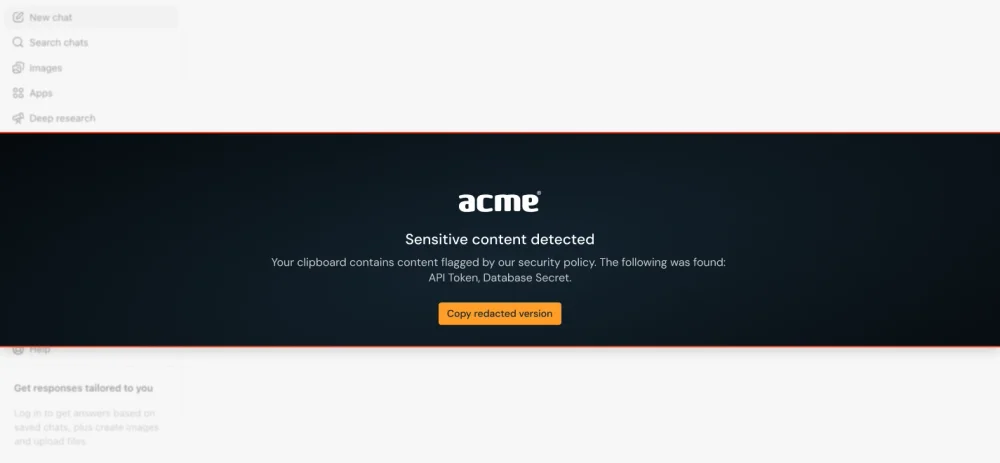
Push enforces data controls across every app accessed through the browser from a single deployment. File upload and download policies (configurable by user group, file type, and file name pattern), clipboard monitoring for sensitive data patterns, AI interaction monitoring that captures what employees share with AI tools, and domain categorization with browser-level blocking — all enforced at the point of interaction, regardless of whether the app has a CASB integration. Graduated enforcement (monitor, warn, or block) lets security teams calibrate controls rather than choosing between blanket blocking and no visibility.
Discover shadow SaaS that bypasses CASB
CASBs discover cloud applications from network traffic patterns or cloud API logs. This works for traffic that routes through managed infrastructure — but employees on BYOD devices, personal networks, or direct browser connections bypass the proxy entirely. HTML smuggling evades download detections, client-side page assembly bypasses traffic signatures, and rapid domain rotation defeats blocklists. The result: the shadow SaaS and unsanctioned usage you most need to find is exactly the usage that bypasses CASB discovery.
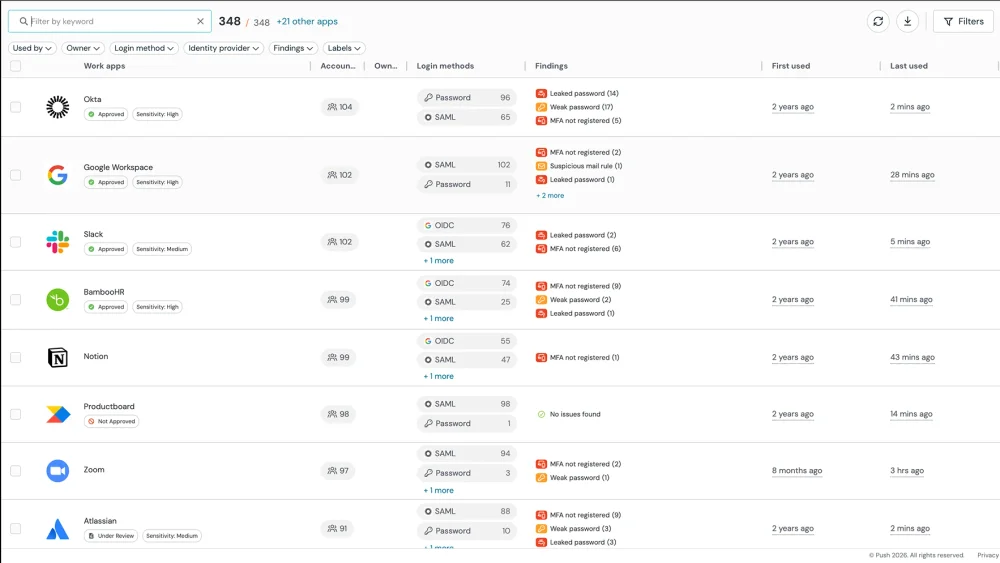
Push discovers every application from browser login events — the actual authentication action, on any device, regardless of network path. Each discovery includes the authentication method (password, SSO, social login, passkey), MFA status, account type (corporate or personal), and password strength. Security teams get full SaaS visibility across managed and unmanaged devices without proxy routing.
Push as a CASB complement — or alternative
Push complements or replaces CASB in the areas that matter most for stopping compromise: browser-layer threat detection that catches attacks before credentials are stolen, credential and session security that CASBs structurally can't provide, browser-wide data controls that work on every app (not just connected ones), and SaaS discovery that works on unmanaged devices. For organizations evaluating whether to renew or expand their CASB deployment, the question is whether the CASB's detection and DLP value justifies the deployment overhead — or whether browser-layer security addresses the higher-priority risks.
| Dimension | Push Security | CASB |
|---|---|---|
| Block unsanctioned apps | Yes — Browser-level domain blocking and SaaS access controls — works on any device, graduated enforcement (monitor, warn, block), no proxy routing needed | Partial — URL/domain blocking at proxy — requires traffic routing, all-or-nothing by domain, users bypass on BYOD or personal networks |
| Prevent data loss | Yes — Browser-layer file upload controls, clipboard monitoring, and AI interaction monitoring — works across every app in the browser on any device, but uses pattern matching rather than enterprise content classification | Partial — Inline DLP with content classification via TLS interception — enterprise-grade but requires proxy routing, breaks some apps with cert pinning, and only covers traffic through the proxy |
| Detect compromised accounts | Yes — Detects compromised credentials at login, phishing pages before credentials are stolen, and session replay via marker injection — catches attacks pre-compromise rather than post-compromise anomalies | Partial — API-based anomaly detection (impossible travel, unusual access patterns) — fires after the attacker already has a valid session, sophisticated attackers evade with residential proxies |
| Discover shadow SaaS | Yes — Browser login events with full auth context (method, MFA status, account type, password strength) — works on any device regardless of network path | No — Network traffic analysis or API logs — misses BYOD, direct browser connections, and personal account usage; no authentication context |
| Control AI data sharing | Yes — Monitors prompts, file uploads, and clipboard activity at the browser layer — graduated enforcement with content-level visibility | No — Block AI domains at proxy or inspect traffic — can't see prompt content with cert pinning, no middle ground between allow and block |
| Monitor OAuth grants | Yes — Captures OAuth consent flow in real time in the browser — can warn or block before the grant is approved | Partial — API-based audit discovers grants after they've been approved |
| Data loss via plugins and extensions | Yes — Full browser extension inventory, permissions analysis, supply chain monitoring, allowlisting | No — No visibility into browser extensions |

Frequently asked questions
A CASB is a security control point between users and cloud applications. It operates in two modes: inline (proxy-based, inspecting traffic in real time) and API-based (connecting to cloud service APIs for configuration auditing and monitoring). CASBs provide shadow IT discovery, DLP, access control, and compliance monitoring for cloud applications — but they can't see inside browser sessions, where phishing, credential theft, and session hijacking occur.
Push complements CASBs by providing the browser-layer security they structurally can't: real-time phishing detection, credential monitoring, session integrity, and SaaS discovery that works on unmanaged devices.
It depends on what your CASB does for you. If your primary CASB use cases are shadow IT discovery and basic SaaS access control, Push may replace that functionality with higher-fidelity browser-based discovery. If you rely on your CASB for enterprise DLP with content classification, API-level SaaS configuration auditing, or compliance controls for regulated data, you still need it.
Most organizations benefit from both: CASB for inline DLP and API-level controls on sanctioned applications; Push for browser-layer threat detection, credential security, and SaaS discovery that works across all devices.
CASBs can't see inside browser sessions. This means they miss: AiTM phishing pages (they see the URL, not the page behavior), credential entry and password quality (they don't observe authentication), session token replay (they have no session-level visibility), browser extension activity (entirely invisible), OAuth consent flows initiated in the browser, and AI tool interactions at the prompt level.
Push operates at the browser layer and detects all of these.
CASBs discover shadow IT from network traffic patterns — analyzing which cloud services appear in proxy logs or firewall data. This misses direct browser logins (especially on BYOD), personal account usage, and the authentication context (SSO vs local login, MFA status, password strength).
Push discovers shadow IT from browser login events — the actual authentication action. Every discovery includes the application, user, authentication method, MFA status, and whether it's a corporate or personal account. This works on any device with the browser extension, including BYOD and contractor devices that don't route through your proxy.
CASBs address cloud application security from the network and API layer, but the browser-layer threats driving most enterprise compromise — phishing, session hijacking, credential theft, OAuth abuse, malicious extensions — execute inside the browser session where CASBs have no visibility.
Push provides real-time detection and response for these browser-layer threats. It also provides higher-fidelity SaaS discovery that works on unmanaged devices. Push isn't a full CASB replacement (it doesn't replicate enterprise DLP or API-level configuration auditing), but it addresses the most critical capability gap in CASB deployments — the browser layer.
For inline DLP and API-level controls, yes — Push provides browser-layer DLP building blocks but not enterprise content classification. For shadow IT discovery, Push may replace your CASB's discovery capability with higher fidelity. For threat detection, Push addresses threats CASBs can't see.
It depends on your CASB use cases. Push can replace or significantly reduce reliance on CASB for: shadow IT discovery (higher-fidelity browser-based discovery), basic SaaS access controls (browser-level blocking and policy enforcement), and threat detection (browser-layer detection of phishing, session hijacking, credential compromise that CASBs can't see).
Inline CASBs require traffic routing through a proxy — impractical for personal devices without MDM-managed VPN or proxy profiles. API-based CASBs monitor cloud service activity but have no visibility into what happens on the device or in the browser.
Push deploys as a browser extension on any device — managed or unmanaged — and provides consistent security coverage across your entire user population. This makes it particularly valuable for organizations with significant BYOD, contractor, or remote work populations where CASB deployment is impractical.
Latest resources


