Browser security vs remote browser isolation
RBI protects against attacks on the browser — malware and code exploits targeting the browser itself. It does nothing for attacks happening in the browser — phishing, credential theft, session hijacking, and malware delivery techniques like ClickFix where the payload executes outside the isolated session entirely.
- Detect phishing, credential compromise, and session hijacking inside the browser session
- Stop ClickFix and clipboard-based attacks that break out of the isolation chain
- Provide the identity and session security layer that isolation architecturally can't








RBI is designed for attacks on the browser — not attacks in the browser
Remote browser isolation executes web content in a sandboxed environment and streams a visual representation to the user's browser. It's designed to stop attacks on the browser — malware, drive-by downloads, and code exploits that target the browser engine itself. Malicious code runs remotely and never reaches the endpoint.
But the attacks that pose the biggest threat to businesses are those happening in the browser. AiTM phishing pages reverse-proxy the real login and capture post-MFA session tokens — no malicious code involved. Credential stuffing replays stolen passwords against legitimate login pages. Session hijacking replays stolen tokens in a completely different browser. OAuth consent abuse exploits a legitimate authorization flow. ClickFix attacks trick users into copying a command and executing it outside the browser entirely — breaking the isolation chain.
RBI faithfully renders all of these to the user because they're page content and user interactions, not code exploits targeting the browser.
Detect and stop attacks that isolation doesn't
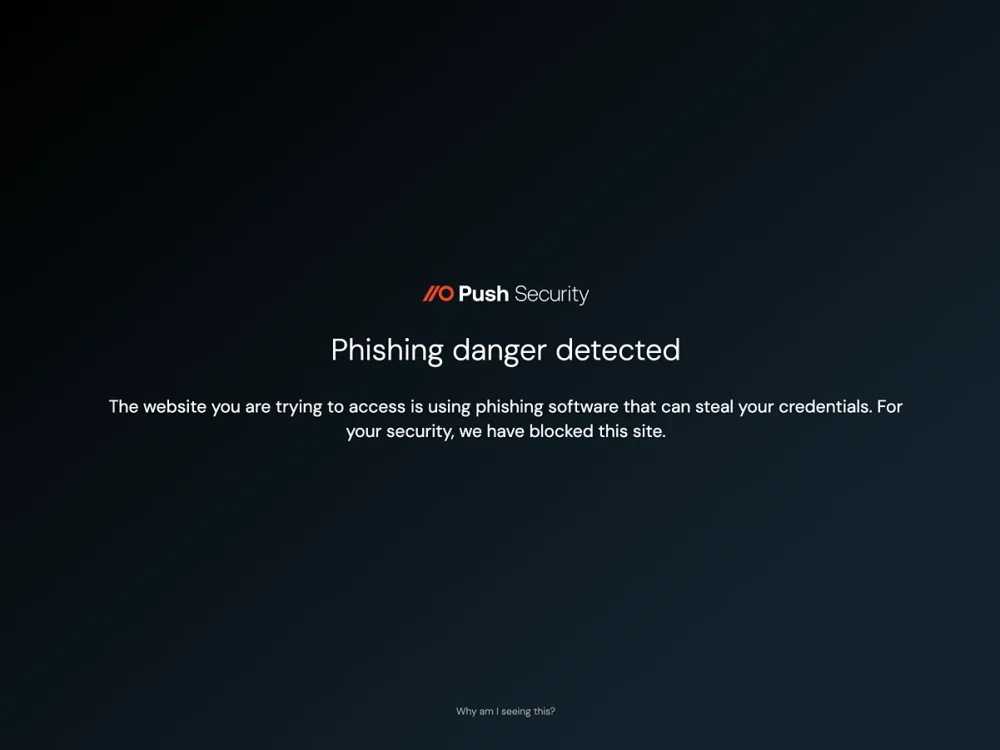
Push operates inside the browser session — the layer where phishing, credential theft, and session hijacking actually execute. Behavioral phishing detection analyzes page structure, script behavior, and credential-harvesting mechanics to catch AiTM kits, device code phishing, and cloned login pages before the user enters credentials. Compromised credential detection flags breached, weak, and reused passwords at the point of login. Session marker injection detects stolen token replay with deterministic proof. OAuth consent monitoring captures every grant with full context and can warn or block before permissions are approved.
These are attacks happening in the browser — targeting identities, credentials, and sessions rather than the browser itself. Push catches them because it analyzes what the user is interacting with inside the session, not where code executes.
Enforce browser-wide controls without isolation overhead
RBI introduces latency (remote rendering), bandwidth consumption (streaming pixels or DOM data), and per-user licensing cost that scales with browsing volume. These trade-offs force most organizations to deploy RBI selectively — isolating only uncategorized URLs, risky categories, or specific user populations. Selective isolation creates gaps: categorized domains that turn malicious, legitimate sites hosting phishing infrastructure, and BYOD users who don't route through the isolation layer.
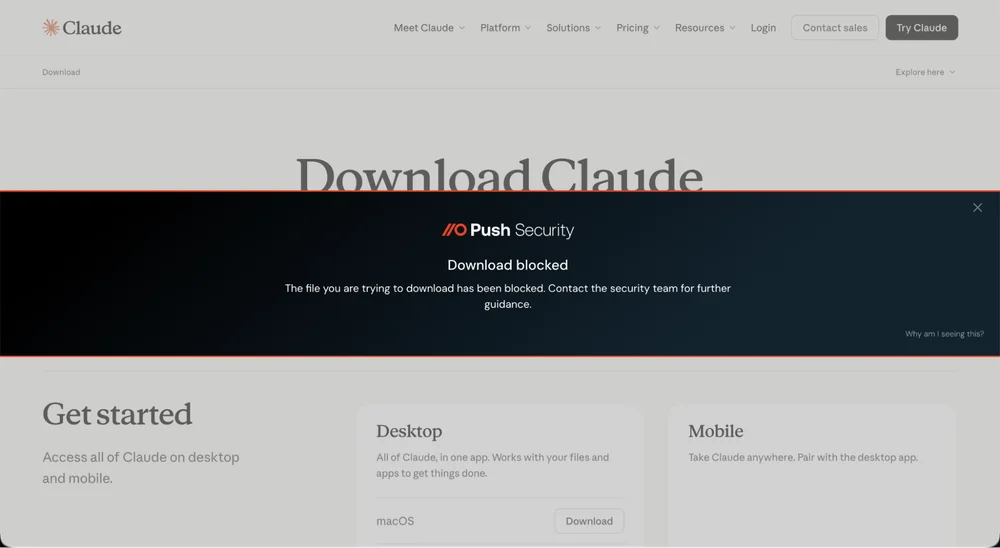
Push deploys as a browser extension with no remote rendering, no latency, and no traffic routing. Security controls operate across all browsing activity on any device: SaaS discovery from login events, browser extension inventory with permissions analysis, file upload and download controls, clipboard monitoring for sensitive data patterns, AI interaction monitoring, and domain categorization with browser-level blocking. These controls work continuously across every app and every session — not just the subset of traffic routed through an isolation layer.
The benefits of RBI, without the drawbacks
Push replaces or significantly reduces reliance on RBI for attacks in the browser — the use cases that motivated most RBI deployments in practice: anti-phishing, protecting users from malicious sites, and reducing browser-based risk. For these outcomes, browser-layer detection is more effective (it actually detects phishing pages, rather than rendering them faithfully), cheaper (no remote infrastructure), and broader (covers all browsing, not just isolated traffic). Many organizations that deployed RBI primarily for anti-phishing are shifting that budget toward real-time browser-layer detection, not isolation.
| Dimension | Push Security | RBI |
|---|---|---|
| Protect against phishing | Yes — Behavioral detection catches AiTM, device code phishing, and cloned pages before credentials are stolen — analyzes page behavior, not URL reputation | No — Renders phishing pages faithfully to the user — no detection, no prevention of credential harvesting. AiTM pages look and function identically in isolation |
| Prevent malware delivery (attacks on the browser) | Yes — Detects ClickFix clipboard injection at the point of interaction and blocks malicious downloads | Partial — Stops drive-by downloads and browser exploits — but ClickFix (the dominant malware delivery vector) breaks the isolation chain because the user copies a command and executes it outside the isolated session |
| Detect compromised credentials | Yes — Detects weak, reused, and compromised passwords at the point of login, including passwords found in infostealer logs | No — No credential visibility — users enter passwords inside isolated sessions with no monitoring |
| Detect session hijacking | Yes — Session marker injection provides deterministic proof when a token from a Push-enrolled browser appears elsewhere | No — No session visibility — stolen tokens are replayed outside the isolated environment entirely |
| Control data sharing with AI tools | Yes — Monitors prompts, file uploads, and clipboard activity into AI tools — graduated enforcement from monitoring through blocking | No — No AI interaction visibility — renders AI tools like any other page with no content-level monitoring |
| Secure BYOD and unmanaged devices | Yes — Browser extension deploys to any device with no traffic routing, remote rendering, or device enrollment | No — Requires traffic routing through isolation infrastructure — impractical for unmanaged devices without proxy or VPN |
| Manage browser extension risk | Yes — Full inventory, permissions analysis, supply chain monitoring, and allowlisting across the fleet | No — No visibility into local browser extensions or their permissions |
| Coverage and cost | Yes — No remote infrastructure — operates natively across all browsing activity on any device | No — Latency and cost scale with usage — most organizations isolate selectively, creating gaps in coverage |

Frequently asked questions
Remote browser isolation (RBI) renders web content in a remote sandboxed environment and streams a visual representation to the user's browser. It protects against attacks on the browser — malware and code exploits that target the browser engine — by ensuring malicious code executes remotely rather than on the user's device. But RBI doesn't detect or prevent attacks happening in the browser — phishing, credential theft, session hijacking, and OAuth abuse all pass through the isolation layer because they're user interactions, not code exploits.
Push operates inside the browser session where these attacks execute: behavioral phishing detection, credential monitoring, session integrity, and SaaS visibility — the identity and session security layer that isolation architecturally can't provide.
RBI intercepts web requests and routes them to a remote rendering engine (cloud-based or on-premises). The remote engine loads and executes the page, then streams the visual output (as pixel data, DOM reconstruction, or a video stream) to the user's local browser. This stops attacks on the browser — code exploits and malware execute remotely rather than on the device. But the user still interacts with page content normally, which means attacks in the browser (phishing pages, credential harvesting, OAuth consent flows) reach the user exactly as they would without isolation.
Push operates inside the browser session rather than isolating it — analyzing page behavior, credential entry, and session integrity in real time. It detects attacks in the browser that isolation passes through, with no remote rendering, no latency, and no traffic routing.
Latency (remote rendering adds delay), cost (scales with usage and is significantly more expensive per-user than browser extension approaches), limited compatibility with some web applications (interactive content, video conferencing, and complex JavaScript applications may render poorly), and selective deployment (cost and latency mean most organizations only isolate a subset of traffic, creating coverage gaps). More fundamentally: RBI protects against attacks on the browser but does nothing for attacks in the browser — AiTM phishing, credential theft, session hijacking, OAuth abuse, and ClickFix all pass through isolation because they target the user's identity and session, not the browser engine.
Push avoids these trade-offs entirely. It operates natively in the browser with no remote rendering, no latency, and no per-session infrastructure cost — detecting attacks in the browser that isolation passes through.
Push replaces RBI for the attacks driving most enterprise compromise today — phishing, credential theft, session hijacking, and OAuth abuse all happen in the browser, where isolation has no visibility. Push detects and stops them with behavioral analysis at the browser layer, and many organizations that deployed RBI primarily for anti-phishing are moving to browser-layer detection because it addresses the threats isolation architecturally passes through.
For organizations that still need code-execution isolation (malware sandboxing, drive-by exploit containment), Push complements RBI by covering the attack surface isolation doesn't reach. The two layers together address both attacks on the browser and attacks in the browser.
Browser isolation renders web content remotely, preventing attacks on the browser — malware and code exploits execute in the remote environment rather than on the device. A browser security extension operates inside the local browser, detecting attacks in the browser — phishing, credential theft, session hijacking, OAuth abuse — by analyzing activity in real time.
Push is a browser security extension. It addresses the attacks that isolation passes through: identity and session threats that operate within rendered page content. The two approaches are complementary — isolation stops code execution, Push stops credential harvesting, session theft, and the rest of the attack surface that isolation can't see.
RBI requires remote rendering infrastructure that scales with browsing volume. Every page load consumes compute, bandwidth, and streaming resources in the isolation environment. Licensing is typically per-user and significantly higher than browser extension approaches, and total cost increases with usage intensity.
Push deploys as a browser extension with no remote infrastructure requirements. Detection happens locally in the browser, with only detection events and matched telemetry transmitted to the Push platform.
The leading RBI vendors include Zscaler (integrated into their SSE platform), Menlo Security (cloud-based isolation), and Cloudflare (part of their Zero Trust platform). Each provides browser isolation with different architectural approaches and integration models.
If you're evaluating RBI alternatives specifically for phishing detection and identity security, consider whether browser-layer detection (Push) addresses your primary use case more effectively than isolation. RBI and browser security solve different problems — understanding which threats you're prioritizing determines which approach delivers more value.
Phishing is an attack in the browser, not an attack on the browser — so isolation doesn't help. RBI renders phishing pages faithfully to the user. The user sees and interacts with AiTM pages, credential-harvesting pages, and device code phishing pages exactly as they would without isolation, because these are page content, not code exploits.
Push detects phishing pages behaviorally — analyzing page structure, script behavior, and credential-harvesting mechanics to identify the attack before the user enters credentials. Detection targets the page's behavior, not its URL reputation, so it catches novel infrastructure that URL filtering would miss.
Latest resources


