EvilTokens
- Technique
- Authorization phishing
- Sub-technique
- Device code phishing
- Targeted platforms
- Microsoft
Updated · First published
Current breakthrough rate
Moderate
- Mar 2026: High
- Apr 2026: High
- May 2026: High
- Jun 2026: High
- Jul 2026: High
- Aug 2026: High
- Sep 2026: Moderate
EvilTokens was a device code phishing toolkit that appeared in February 2026. It rapidly become one of the most prevalent phishing services and was consistently one of the top 5 phishing kits detected by Push Security from March through June 2026.
Its success may have stemmed from the relatively untapped potential of device code phishing prior to its emergence. A device code phishing attack does not require the victim to enter their password on a malicious domain and recipients may have had less familiarity with this type of attack (employees are trained that phishing asks for passwords). In fact, the victim interacts with the legitimate Microsoft OAuth identity provider during the attack.
Microsoft announced the disruption of EvilTokens in September 2026.
The face of device code phishing
Following the launch of EvilTokens in February 2026, there was a surge in device code phishing attacks. Many other device code phishing kits sprang up, and device code phishing lures were also incorporated into existing PhaaS solutions. In multiple cases, the lure templates were directly copied from the EvilTokens kit.
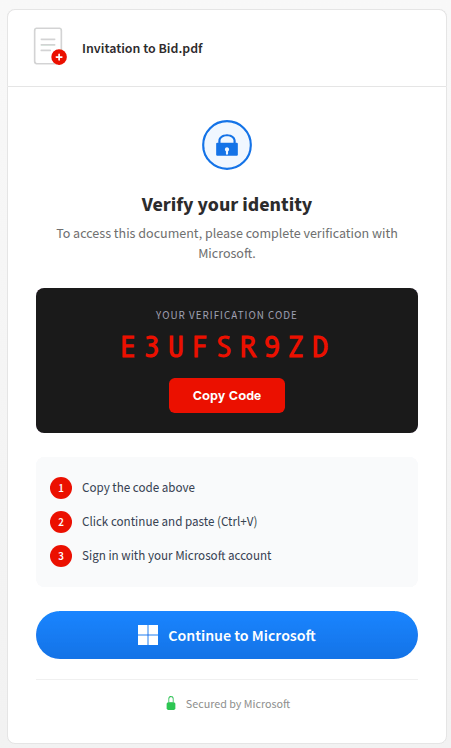
EvilTokens
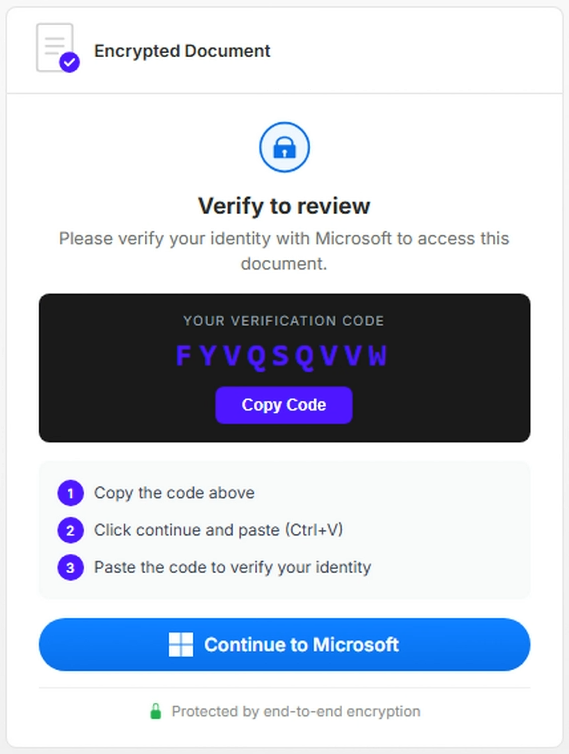
LINKID
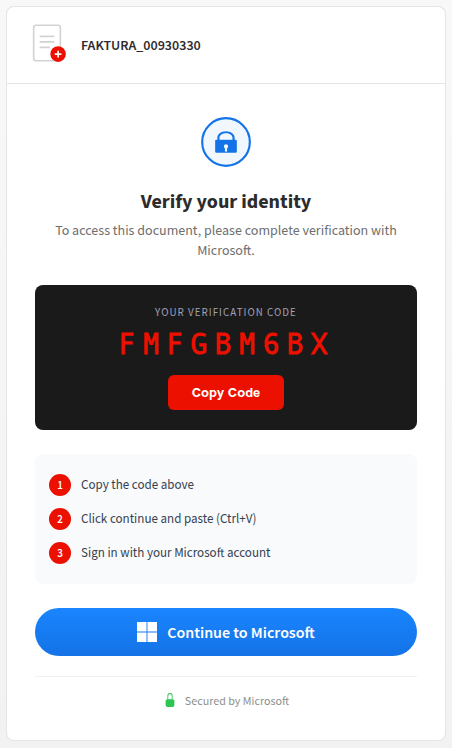
ARToken
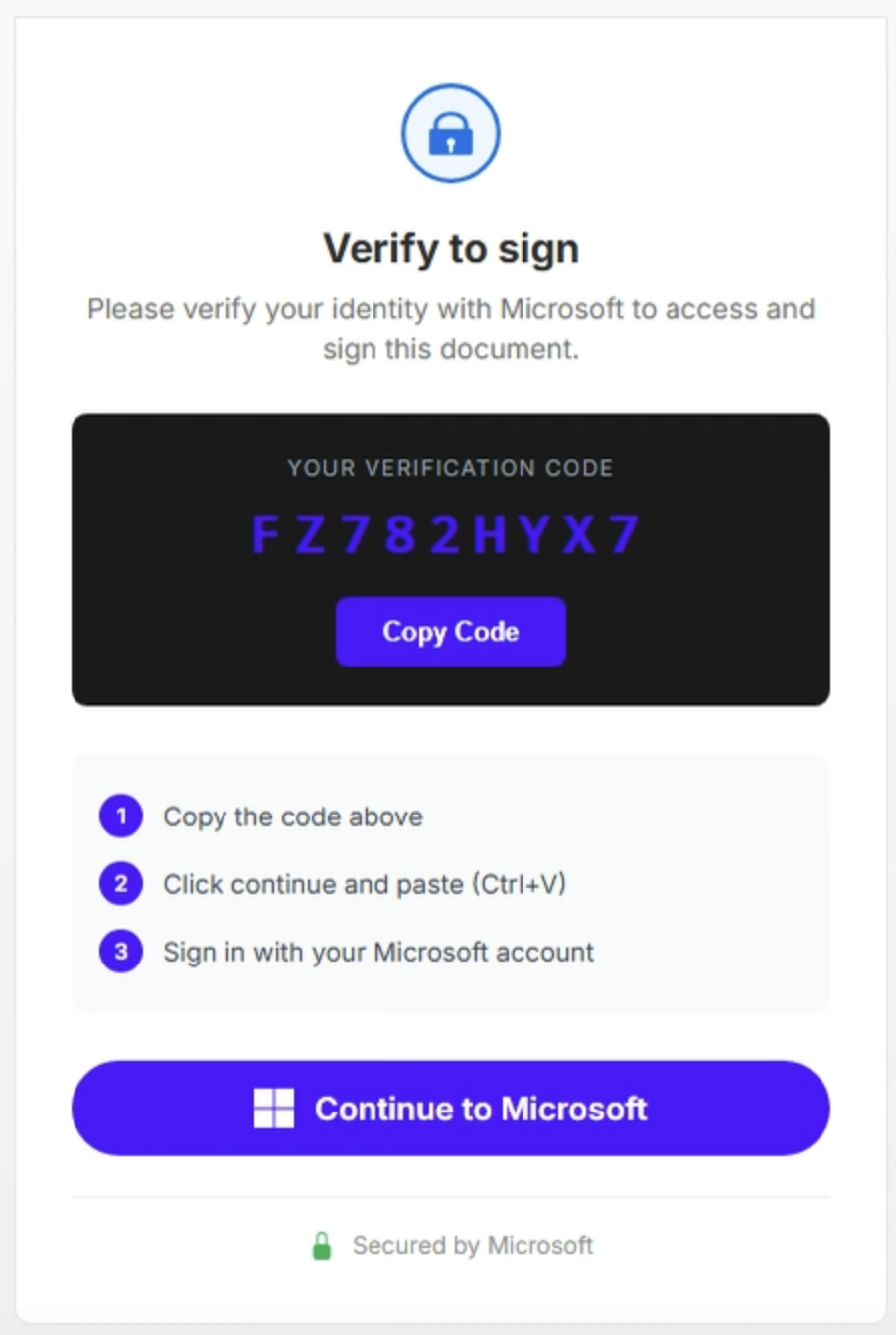
VENOM
URL patterns
The large majority of EvilTokens phishing pages are reached on Cloudflare Workers domains. Two primary subdomain structures have been observed:
[lure-token]-[3-char].[email]-s-account.workers.devwhere lure token was a string such asindex,docusign,voicemail,sharepoint, etc.[4-char]-[4-char]-[4-char].[email]-s-account.workers.dev
Network traffic
Upon reaching the EvilTokens landing page, a background request is made for a new device code authentication session to be started.
POST /api/device/start HTTP/1.1
Host: j80y-4lzt-hxcg.shevy-jassir-dropons-com-s-account.workers.dev
X-Antibot-Token: 1dad3cd63b87fa99eca7111280593e79945c02a1c4f554b2551d0a89320473da
Content-Length: 0

HTTP/1.1 200 OK
{"sessionId":"dev_1771696357459_4gal01vnh",
 "userCode":"E7HJFHDVZ",
 "verificationUri":"https://login.microsoft.com/device",
 "expiresIn":900}
The custom X-Antibot-Token header and HTML comments referencing "anti-bot" behaviours was behind
Push Security's internal naming of "ANTIBOT" when we first started tracking this threat in late February 2026.
By mid-2026 this endpoint had been changed to POST /api/session/init.
After displaying the device authentication code to the victim, the page then polls a status endpoint to determine if authentication has occurred:
GET /api/device/status/<id> HTTP/1.1

{"status":"pending"}  →  {"status":"completed"}
This endpoint was later changed to /api/session/status/<id>.
Representative samples
Sample URLs
hxxps://afj5-qi87-u2kv[.]saras-burnabynh-ca-s-account[.]workers[.]dev/8992f1554dff9929
urlscanhxxps://nijg-dcrh-w47s[.]dylan-pymmand-co-uk-s-account[.]workers[.]dev/c43acd69190af322
urlscanhxxps://webplugins_services_xclient_sessionauthfrontend_drive-com[.]peruonice[.]com/fc668b602aee0c07
urlscanhxxps://sharepoint-3ni[.]sandhiprakash-bhide-nanusens-com-s-account[.]workers[.]dev/4c1a3954bf03d207
urlscanhxxps://chronos-sarl-xbw[.]1c4a473a7a5c2da254228e99[.]workers[.]dev/720864c36c2fb271
urlscanhxxps://hamelcontrol[.]com/?email=
urlscan
Public analysis
Third-party research on this tool.
- Paul NewtonUncovering a New Device Code Phishing Campaignnewtonpaul.com
- Paul NewtonDevice Code Phishing Campaign - Infrastructure Updatenewtonpaul.com
- HuntressRiding the Rails: Threat Actors Abuse Railway.com PaaS as Microsoft 365 Token Attack Infrastructurehuntress.com
- SekoiaNew widespread EvilTokens kit: device code phishing as-a-servicesekoia.com
- MicrosoftUnmasking EvilTokens: Getting to the root of device code phishingmicrosoft.com