
'%3e%3cpath%20d='M248.027%20159.993C292.176%20159.993%20328.105%20124.1%20328.105%2079.996C328.105%2035.892%20292.191%200%20248.027%200C203.863%200%20167.95%2035.892%20167.95%2079.996C167.949%20124.101%20203.878%20159.993%20248.027%20159.993ZM213.969%2045.973C223.069%2036.882%20235.155%2031.873%20248.027%2031.873C260.899%2031.873%20272.986%2036.882%20282.086%2045.973C291.186%2055.064%20296.2%2067.154%20296.2%2079.997C296.2%2092.84%20291.186%20104.93%20282.086%20114.021C272.986%20123.112%20260.899%20128.12%20248.027%20128.12C235.155%20128.12%20223.069%20123.111%20213.969%20114.021C204.869%20104.93%20199.871%2092.84%20199.871%2079.997C199.871%2067.154%20204.884%2055.063%20213.969%2045.973Z'%20fill='%23EE4323'/%3e%3cpath%20d='M150.16%200L57.6821%20159.993H94.5381L187%200H150.16Z'%20fill='%23EE4323'/%3e%3cpath%20d='M92.478%200L0%20159.993H36.856L129.334%200H92.478Z'%20fill='%23EE4323'/%3e%3c/g%3e%3cdefs%3e%3cclipPath%20id='clip0_296_834'%3e%3crect%20width='328.105'%20height='159.993'%20fill='white'/%3e%3c/clipPath%3e%3c/defs%3e%3c/svg%3e)


Secure shadow SaaS
Employees sign up for tools long before those apps appear in any security review. Push sees it when and where it happens: in the browser. Every app in use, visible, with controls to reduce exposure before it becomes an incident.
- Discover every SaaS app users access, managed or not
- Spot accounts with weak security postures like missing MFA, unmanaged access, and no SSO
- Control usage with in-browser prompts, blocks, and security guardrails








Use your browser to curb SaaS sprawl
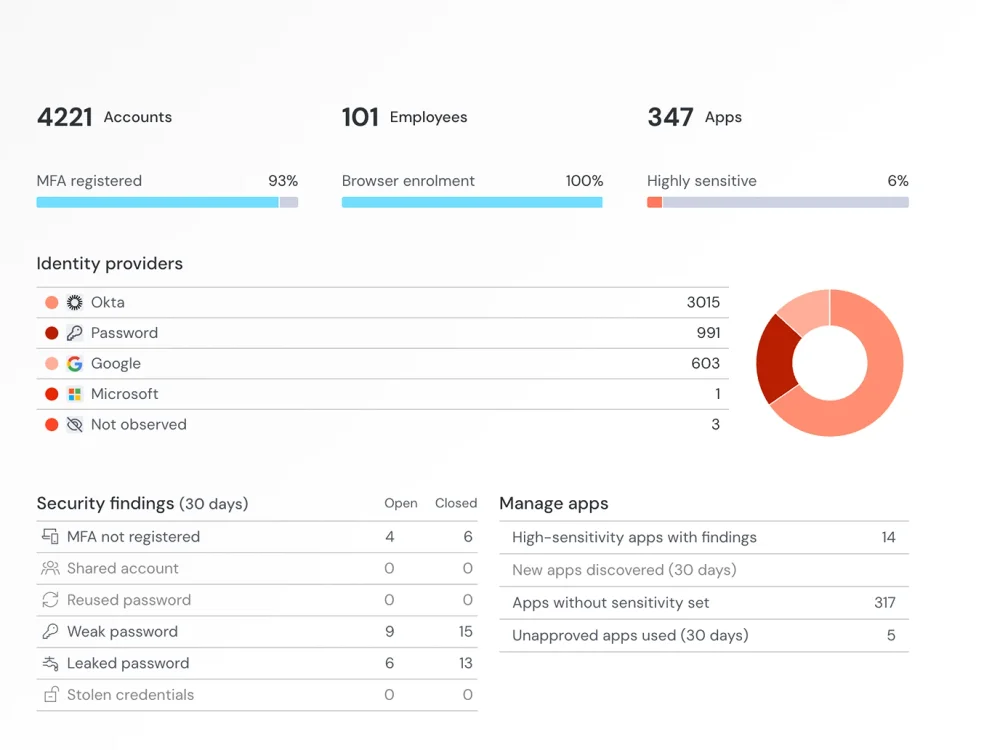
Shadow SaaS doesn’t appear in network scans or application inventories. It appears when users sign into tools directly from the browser. From free trials to unsanctioned file sharing platforms, these accounts often exist outside SSO and outside security policy. Push continuously maps your organization’s SaaS footprint by observing authentication activity in the browser, exposing apps and accounts that would otherwise remain invisible.
Discover hidden SaaS usage
Push captures live browser telemetry across every tab and session. Whether someone signs into a corporate SaaS tool with a personal account or adopts a new application without IT approval, Push surfaces that activity immediately without requiring API integrations or manual discovery.
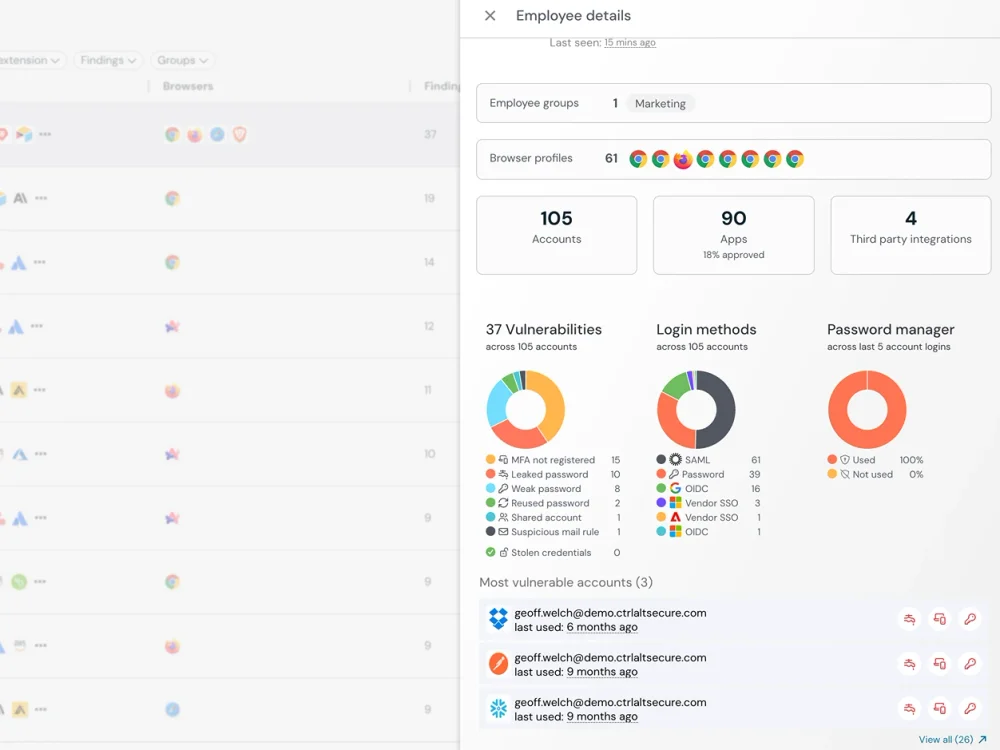
Spot risky access and unsafe usage
Once applications are discovered, Push helps security teams understand which ones introduce real risk. It highlights apps with weak authentication protections, accounts without MFA, and services that bypass centralized identity controls. This context helps teams quickly identify where exposure exists and which users or accounts require attention.
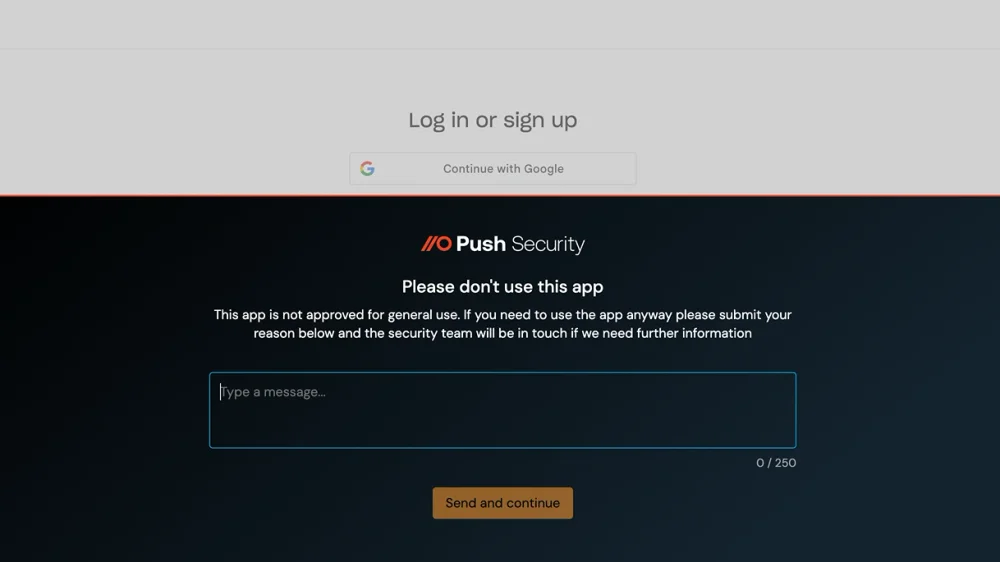
Close gaps before they grow
Push also gives security teams the ability to act on what they discover. When risky SaaS usage appears, teams can guide users to enable stronger authentication, block access to high-risk applications, or apply browser guardrails that enforce safer behavior. Controls are applied directly in the browser, enabling organizations to reduce SaaS risk without deploying new infrastructure or managing complex integrations.
Frequently asked questions
Cloud applications used by employees without IT approval or security oversight — tools adopted through self-service signup, often with corporate email addresses and direct passwords. These sit outside your IdP, CASB, and security monitoring.
Each creates an unmanaged identity with potentially weak credentials, no MFA, and no monitoring. Push discovers shadow SaaS from actual login events in the browser.
CASB discovers apps from network traffic patterns, but only sees traffic that routes through the proxy and can't determine how users authenticate. Email-based discovery scans signup confirmations but generates high false positive rates and misses accounts created with personal email addresses. API-based discovery only covers apps you already know about and have integrated with — and not every app offers the right APIs at every pricing tier. Procurement records and manual surveys miss free-tier signups and self-service adoption entirely.
Push discovers shadow SaaS by observing actual login events in the browser. Every time an employee logs into an application, Push captures the app, authentication method, password strength, and MFA status — showing not just that an app is in use, but the security posture of the account.
Network-based discovery (CASB, SWG logs, firewall logs) shows traffic to app domains but misses apps accessed outside the corporate network — personal VPN, mobile hotspot, home network. It also can't tell you whether the user logged in with SSO or a direct password, whether MFA was enabled, or whether the password is compromised.
Push discovers SaaS applications from actual browser login events regardless of network path, with full authentication context: SSO vs. password, MFA status, password strength, and account sharing patterns.
A tool that discovers applications from actual user behavior rather than network traffic or procurement records. CASB misses apps accessed outside the corporate network. IT asset management misses self-service signups.
Push discovers SaaS from browser login events, capturing authentication method, credential strength, and MFA status alongside the application identity.
CASB discovers SaaS from network traffic patterns. Push discovers SaaS from browser login events with full authentication context (method, credential strength, MFA status).
CASB misses apps accessed outside the corporate network. CASB can identify that an app was accessed; Push tells you how the user authenticated and whether their password is compromised.
SWGs and firewalls can block known domains at the network layer, but they require traffic routing through the proxy (no coverage on BYOD or off-network), operate at the URL level with no application-level granularity, and offer a binary block-or-allow choice. Conditional access policies can restrict access to managed apps, but shadow SaaS by definition sits outside your IdP.
Push provides application-level blocking at the browser layer — specific apps, categories, or all apps not on an approved list. For graduated enforcement, Push supports app banners (guidance without blocking), warning mode, and full blocking. Domain categorization covers 89 categories.
Significantly more than IT knows about. Push's discovery typically surfaces 2-5x the number IT and procurement are tracking. The gap comes from self-service signups, free tier tools, personal accounts used for work, and tools adopted by individual teams. Each undiscovered app is a potential unmanaged identity with weak credentials and no monitoring. See Push's discovery data.
Unmanaged identities with no IdP oversight — weak or reused passwords, no MFA, no conditional access, no monitoring. These accounts are invisible to your security stack and persist indefinitely, creating entry points for credential stuffing, ATO, and data exfiltration.
Additional risks include data in unmanaged apps (outside DLP), OAuth integrations connecting shadow apps to corporate data, shared accounts, and compliance violations.
No. Your IdP only sees federated applications. Shadow SaaS by definition exists outside SSO — users sign up with direct passwords through the app's own login system. Your IdP never sees these events.
Push sees every login event in the browser regardless of authentication method.
Outright blocking drives usage underground. A more effective approach combines visibility, risk assessment, guardrails (enforcing security standards on apps that stay), and guided alternatives.
Push supports graduated governance: discover → assess → deploy app banners with guidance → enforce credential hygiene → block only the highest-risk tools.
When employees use personal email accounts (Gmail, Outlook) to sign up for work tools, the resulting accounts sit entirely outside organizational control. You can't enforce MFA, apply password policies, revoke access during offboarding, or monitor usage. If the employee leaves, they retain access to any work data in those accounts.
Personal account signups also create tenant confusion — the employee may use a personal account on a tool the organization officially uses, creating a parallel access path outside the managed tenant. Push detects personal account logins and can surface in-browser guidance nudging users toward their organizational account. Read about shadow SaaS risks.
The uncontrolled growth of SaaS applications across an organization — driven by self-service signup, departmental purchasing, free-tier adoption, and shadow IT. SaaS sprawl creates overlapping tools, wasted licensing, and a growing identity attack surface as each new app represents another set of credentials and permissions to manage.
The security impact compounds: more apps mean more unmanaged identities, more password reuse, more OAuth integrations, and more data stored outside governed platforms. Push quantifies SaaS sprawl through browser-based discovery — showing every application employees actually use, how they authenticate, and the credential security posture of each.
Latest resources


